Our facility covers over 25,000 m² , providing ample space for production and future expansion.
We employ over 100 staff, of whom professional and technical personnel account for 10% and frontline production workers for 70% — a well-balanced and efficient workforce structure.
The plant is equipped with more than 130 sets of advanced production machinery, enabling automated manufacturing that ensures process efficiency and operational stability.
We are certified to IATF 16949 and apply Statistical Process Control (SPC) throughout production to safeguard product quality.
With an annual production capacity exceeding 2.5 million pieces, we are fully equipped to fulfill large-volume orders.
Recognized as a High-Tech Enterprise and a “Specialized, Refined, Differentiated and Innovative” (SRDI) Enterprise, we hold more than 20 patents.
Product Series Overview
Complete gear series, fully manufactured in-house as your OEM partner
Our factory operates more than 120 units of production and inspection equipment, with over 50 new units commissioned since 2023 as part of ongoing capacity upgrades. All key stages of the gear manufacturing chain — turning, gear cutting, heat treatment, gear grinding and metrology — are completed in-house, giving us direct control over precision, consistency and lead times.
Precision machining is anchored by five gear grinding machines, including Qinchuan CNC worm-wheel gear grinders (YK7240 / YK7230) and a LUREN CNC profile gear grinder (LFG-3540), supported by an Italian-made shaving-cutter grinder. Gear cutting capacity spans more than 40 hobbing, shaping and shaving machines, among them twelve brand-new CNC gear hobbers commissioned in 2026.
Carburizing runs in controlled-atmosphere multi-purpose furnaces, followed by shot blasting for surface strengthening. For verification, a gear measuring center (HT400), a universal gear measuring instrument and an optical emission spectrometer check tooth geometry, case depth and material chemistry before parts leave the plant.
Quality Control
How Heavy-Duty Truck Gears Are Made: From Steel Blank to Finished Gear
Every heavy-duty truck on the road carries tens of tons of freight, and a big part of how smoothly it pulls away, shifts and climbs depends on the gears hidden inside its transmission and axles. Small as they are, those gears decide how the whole powertrain feels — pulling power, fuel economy, noise, and how long the truck lasts. For an OEM, a gear supplier you can actually rely on is worth more than one who simply quotes the lowest price. So let’s walk through the full manufacturing chain, from steel blank to finished gear, and answer the questions our customers’ purchasing engineers ask us most.
Step 1 — Material and forging: the gear’s “genes”
Heavy-duty truck gears work under high torque and constantly changing loads. The tooth flank has to resist wear; the tooth root has to take bending. That’s why nearly all of them are made from low-carbon alloy carburizing steels such as 20CrMnTi and 20CrMnMoH. The advantage of these grades: the surface can be carburized and hardened to 58–62 HRC while the core keeps its toughness — hard outside, tough inside, exactly what a gear needs.
The blank is first forged to get proper grain flow, then normalized to improve machinability. This stage looks rough, but it actually sets the stability of everything that follows. If blank material varies, you feel it later in hobbing and heat treatment — small deviations at the start turn into big ones by the end.
Step 2 — Gear cutting: hobbing and milling, balancing speed and accuracy
The teeth are cut by hobbing or milling. Hobbing is the workhorse of gear production — it handles roughly 70% of all gear cutting and is the most efficient way to make gears in volume. For large-module or complex heavy-duty gears, CNC gear milling (our YK2180R CNC gear milling machine, for example) offers more flexibility and handles gear rings and gear shafts with complicated geometries.
This step sets the initial tooth profile and lead accuracy and leaves the right amount of grinding stock. Get the hobbing accuracy right, and the grinding stock stays even — which keeps both final precision and cost under control.
Step 3 — Heat treatment: carburizing and quenching, the gear’s armor
Once the teeth are cut, the gear goes through the most critical stage of the whole chain: carburizing and quenching. In a carbon-rich atmosphere at 900–950°C, carbon diffuses into the tooth surface and forms a hardened case of about 0.5–2.0 mm. Quenching produces a hard martensitic structure, and tempering relieves the stress. The tooth flank ends up at 58–62 HRC, with greatly improved wear resistance.
But heat treatment is also where distortion comes from. Gears deform during heating and quenching, and that directly affects tooth accuracy. That’s why we control loading patterns and heating curves and use dedicated fixtures to suppress distortion — this is where an experienced gear plant separates from an ordinary machine shop. It’s the same point leading transmission makers such as Dongfeng Longqing emphasize in their own manufacturing talks.
Step 4 — Gear grinding: the last mile of accuracy and quiet running
After heat treatment, gears need grinding to remove distortion and reach final accuracy. CNC gear grinders (like our LFG-3540) dress the tooth flank with precision wheels, holding tooth profile and lead errors to micron level. For heavy-duty truck gears where noise and vibration matter, “carburize + grind” is the standard route — which is also why the industry still debates the hob-and-shave route versus grinding. Grinding gives higher accuracy and a smoother flank, but it costs more.
After grinding, gears are shot-peened, which leaves compressive residual stress in the tooth root area and further improves fatigue strength.
Step 5 — Inspection: let the data speak
Every finished gear goes through a final check: tooth profile, lead, pitch, radial runout, case depth, surface hardness — backed by a gear measuring center and Cpk statistics to keep batch-to-batch consistency. A supplier worth working with hands you complete inspection reports and SPC data, not just promises.
From a purchasing engineer’s point of view: four things to look for in a gear supplier
• Complete process chain. Are forging, cutting, heat treatment, grinding and inspection all done in-house? The more you outsource, the harder quality is to trace.
• Accuracy and certifications. Can they commit to specific accuracy grades (ISO 1328 / DIN)? Are they IATF 16949 certified and running SPC/Cpk?
• Batch consistency. Gears are made by the hundreds of thousands. A single good sample means little if the next batch doesn’t match.
• Capacity and lead time. Can they keep up with your production schedule and project timeline?
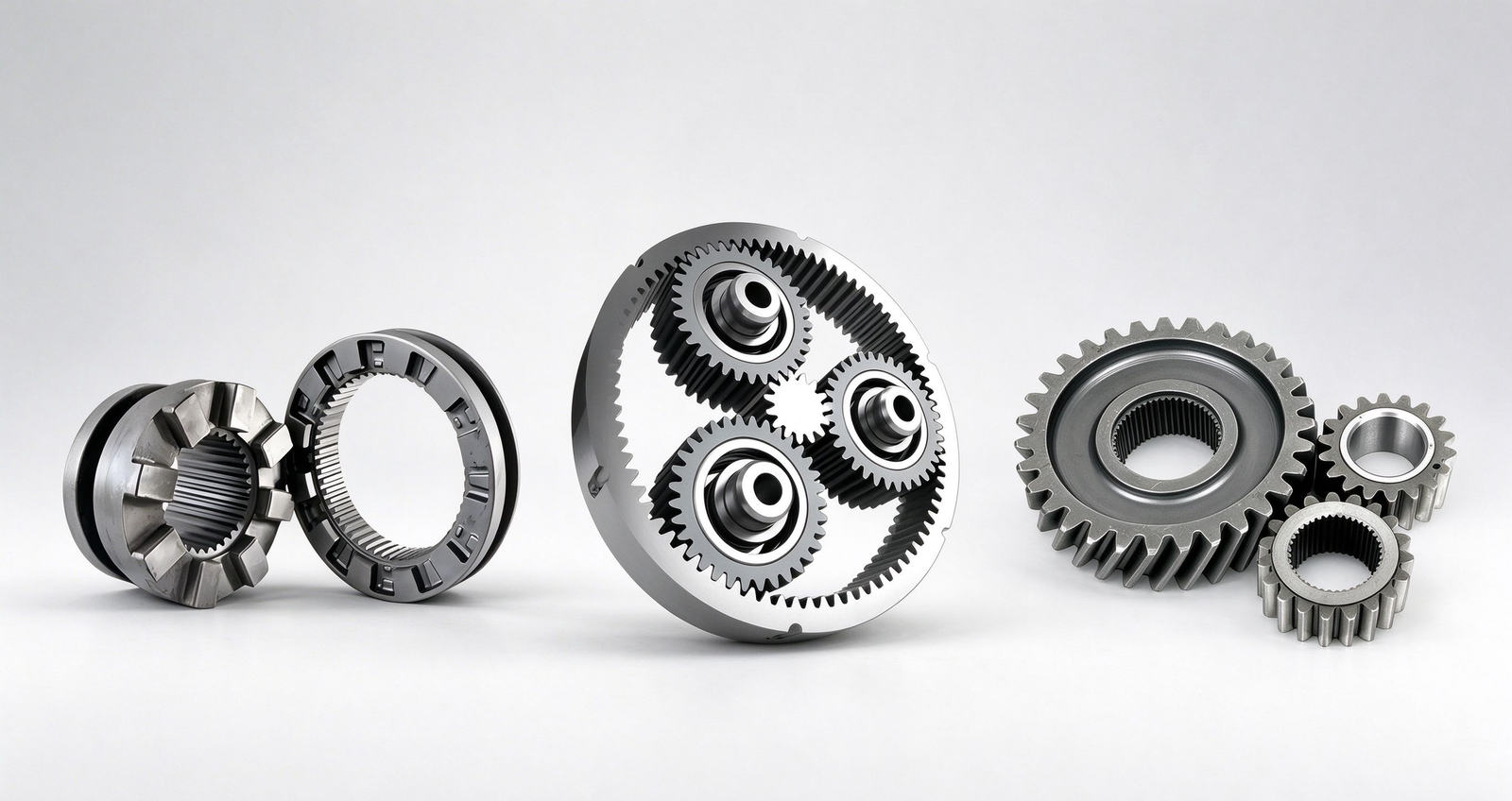
Take our own plant as an example, was founded in 1988, covering 25,000 m² with more than 130 machines — hobbing, milling, grinding and heat treatment all in-house — and an annual capacity of over 2.5 million pieces. We are IATF 16949 certified, recognized as a National High-Tech Enterprise and a “Specialized, Refined, Differentiated and Innovative” (SRDI) enterprise, and we supply leading OEM groups including Sinotruk, Lonking, Weichai and Hande Axle. Our core products — wheel-hub planetary and sun gears, cylindrical gears, synchronizer sleeves and transmission gears — are made along exactly the chain described above.
Gear making is a slow craft. Every micron of accuracy comes from materials, process and management accumulated over years. For an OEM, a partner with a complete process chain, traceable data, and the willingness to grow with you over the long run is worth far more than the cheapest quote you can find.